

 Home appliances are necessary for comfort and efficiency. They literally make life easier for everyone. The only problem is that they all demand electricity to run and some use up much more power than others. Hence, while you enjoy the convenience of warm water or cool air regularly, your electric bills keep rising higher.
A typical home uses energy in the following way:
- Air conditioning and heating – 46%
- Water heating- 14%
- Lighting – 9%
- Appliances – 13%
- TV and other media – 4%
Of course, these numbers might shock you. If you are searching for the best way to cut down on your energy bills, you must start by knowing what uses the most electricity in your home. These big eaters will have to be controlled to help you save significantly. Read on to learn about them.
Air conditioning
The air conditioner is one of the most demanding electrical appliances in the home. On its own, this appliance takes up to 19% of electrical power. It is frequently used during summer months to keep the heat at bay and enjoy cool air.
Saving on the air conditioner can be tough but also easy with the right practices. Start by getting an upgrade to a smart thermostat. The thermostat will make cooling schedules work better to save energy. Wear light clothing in the house and sometimes use cost-efficient methods of cooling. These include opening up a window and using fans.
Water heater
The water heater is used more often than the air conditioner, especially on cold days. We rely on water heaters daily for various needs such as showers, washing dishes, and clothes.
You can save on energy by reducing the temperature of your water heater. Change the presetting to 20 degrees and combine this with other saving tips such as low-flow showerheads and faucet aerators. Take shorter showers and use cold water for washing sometimes. Maintain your unit with a professional electrician to improve its efficiency.
Lighting
Saving on lighting is quite simple and should be almost unnecessary if you have taken the right precautions earlier. Throw out the old-school incandescent bulbs and replace them with LED lights. LED lights last much longer and use far less electricity.
Refrigerator
A typical home refrigerator runs for 24 hours on every day of the week. It only goes off when the power does too. But like any other appliance on this list, the refrigerator consumes as much power as it gives. If you don’t have a refrigerator yet, the good news is you can just buy the new and energy-efficient models. If not, you can employ a few strategies to cut down.
Proper maintenance is important to help your appliances work better and use less power. Clean the vents and coils of this appliance regularly and replace any broken parts like the rubber gaskets. Don’t keep the door open for too long and set the refrigerator’s temperature lower.
All saving tips must be practiced consistently to see results.
 Flickering lights are almost impossible to ignore. They can be very annoying and dangerous if not solved. Flickering lights can be fun and raise no cause for alarm if the lights in question are decorative lights.
  A lot has changed with the way homes are built and
 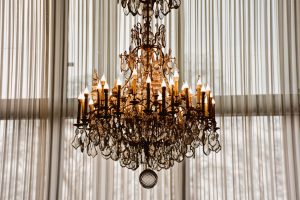 Chandeliers are valuable lights admired for the elegance and lighting quality they bring to a room. Any chandelier can add glamour and beauty to a home or even a commercial building. They come in various sizes, shapes, and designs. Some people believe that chandeliers are for high ceilings and dining rooms. A chandelier is actually quite versatile as it can be used in any part of the home and with both low and high ceilings.
 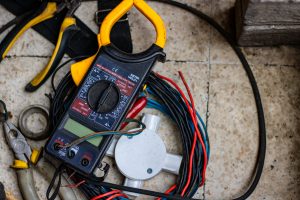 Rewiring is one of the most difficult, messy, and disruptive maintenance projects you can perform in the home. It is equally time-consuming and costly but very necessary. The lifespan of the electrical installation in a home is usually 25 years. However, this duration can vary depending on use. The electrical system will have to be inspected every 10 years if it is in a privately owned property or every 5 years for a rented property. This inspection guarantees electrical safety.
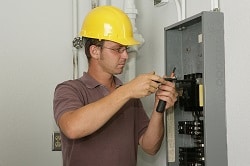 The words ‘electrical contractor and electrician’ are often used interchangeably. Many people do not know the difference between both but assume they mean the same thing. In this article, we will discuss what an electrical contractor does and how they are different from an electrician.
 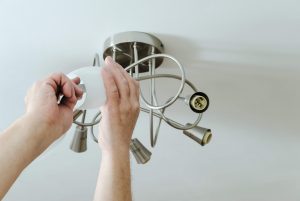 We often see light fixture installations as the easiest tasks of an electrician. Hence, most people try to do them without professional help. A light fixture is described as an electrical device containing an electric lamp. They usually come with an installed switch for users to control the light. For light fixtures to work, they must be connected to a power source. Common examples are your ceiling lights, chandelier, outdoor lights and so on.
  An electrical contractor will always tell you that good lighting is everything. These are not empty words as both homeowners and store owners can agree. The benefits and functions of light in any location are numerous. It is one of the primary reasons we use electricity. Lighting illuminates a space to give you clarity and vision, but in contemporary times they do even more. Lights can boost your business in a commercial building. They can improve security, productivity, and efficiency. Also, studies have shown that lights can be associated with good mood and a relaxed mind.
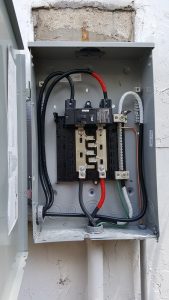 Panel upgrades are large projects. They require the expertise of a professional electrician and a good investment in funds. The electrical panels of a home contribute to its overall efficiency. In this modern age, we all rely so much on power to complete day-to-day activities. This power is distributed by the electrical panel of a home or building.
 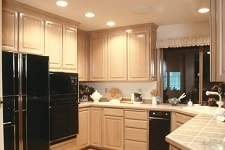 Recessed lighting are also known as downlights. They differ from regular lighting that drops from the ceiling. Recessed lighting is installed within the ceiling and only the shining light can be seen. They appear as a light shining from a hole in the ceiling.